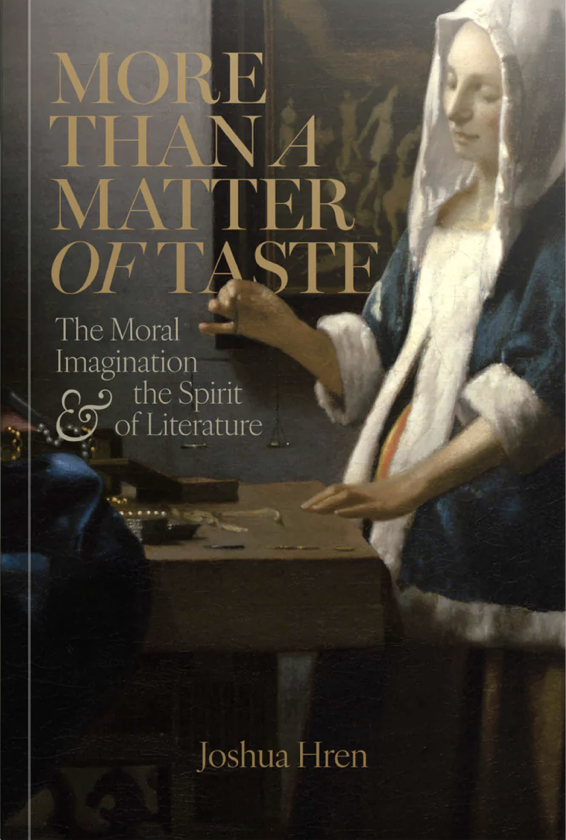
More than a Matter of Taste: The Moral Imagination and the Spirit of Literature
by Joshua Hren
Virtue scores
Review
SECTION ONE Word on Fire has built its publishing identity on the conviction that culture — art, music, architecture, film — is not decoration around the edges of Christian life but a primary site where the human spirit either opens toward God or closes against him. 'More than a Matter of Taste' takes that conviction and applies it to the question of aesthetic judgment: why it matters what you find beautiful, why 'I just like what I like' is not a sufficient account of the life well lived, and what a properly formed sense of beauty actually looks like. The book is addressed to Catholics and serious Christian readers who suspect that taste is morally and spiritually significant but lack the vocabulary or argument to say why. It is also a provocation for anyone who has absorbed the ambient cultural assumption that aesthetic preferences are purely private — a kind of refined relativism that the book sets out to dismantle. SECTION TWO - **Created**: The book's central claim — that beauty is objective and that the capacity to perceive it is native to the human person — rests on an implicit affirmation of the imago Dei. The human being is made, in the Catholic tradition, as a creature capable of knowing truth, willing the good, and perceiving beauty; these are not arbitrary additions to personhood but constitutive of it. By arguing that taste is formable and that some judgments are better than others, the book honors the unity of intellect and appetite that Vitz, Nordling, and Titus locate at the center of a Catholic anthropology of the person. - **Fallen**: The book addresses, at least implicitly, the disordered appetite that Aquinas describes as concupiscence in the domain of aesthetic experience: the tendency to pursue sensory pleasure without reference to the true and the good, to consume beauty as a commodity rather than receive it as a gift. A culture saturated in advertising — which, as McKee's research documents, learned early to weaponize pleasure and pain as marketing levers — trains the appetite toward shallow satisfaction rather than genuine encounter with the beautiful. - **Redeemed**: The book points toward the formation of taste as a genuine exercise of virtue — specifically, the cultivation of a judgment that can reliably distinguish the merely pleasing from the genuinely beautiful. This is a Thomistic claim: that the appetites can be educated, that repeated right perception builds a stable disposition, and that this disposition is ordered toward worship when it opens the person to the transcendent through the sensible. - **Justice (worship and adoration)**: Aesthetic formation, on this account, is not aestheticism. The end of properly ordered taste is adoration — the movement of the whole person toward God through the beautiful things of the created order. The book's publication context (Word on Fire, whose explicit mission is evangelization through culture) reinforces this: beauty well perceived is a threshold, not a destination. - **Prudence (understanding)**: By arguing that taste is formable rather than merely given, the book trains the reader in prudence-understanding — the capacity to grasp the universal principles (beauty as transcendental, the ordered hierarchy of pleasures) that should govern particular aesthetic choices. SECTION THREE McKee's[^1] account in *Storynomics* of how meaning shapes sensory perception — 'the meaning of the perception, not the sensory experience alone, determines how much pleasure or pain people experience'[^1] — illuminates what is at stake in this book's argument: if the interpretive frame placed around an aesthetic encounter transforms the experience itself, then the formation of that frame (which is precisely what taste is) becomes a serious moral and spiritual matter, not a private preference. ## References 1. McKee, Robert (n.d.). *Storynomics*. — 'the meaning of the perception, not the sensory experience alone, determines how much pleasure or pain people experience'
✓ Strengths
- ✓Published by Word on Fire, the book operates within a tradition that treats beauty, art, and culture as legitimate pathways to God — affirming the Catholic conviction that the created order is charged with meaning and that aesthetic experience can be genuinely ordered toward worship.
- ✓The title's insistence that taste is 'more than a matter' of personal preference gestures toward an objective account of beauty, resisting the reduction of aesthetic judgment to mere subjectivity — a position consonant with Aquinas on truth, goodness, and beauty as transcendentals.
- ✓By situating aesthetic culture within a theological frame, the book invites readers to exercise prudence-understanding: grasping the universal principles that underlie particular artistic and cultural choices rather than consuming culture unreflectively.
- ✓The Word on Fire imprint signals an audience already oriented toward evangelization through culture, so the book's arguments about taste and discernment directly serve the formation of judgment — a practical exercise of sound judgment (prudence) in the domain of cultural life.
- ✓Insofar as the book reclaims the category of objective beauty against a purely consumerist or relativist aesthetics, it implicitly addresses the fallen tendency toward disordered desire — the appetite that pursues pleasure divorced from truth — and redirects it toward right appreciation.
⚠ Considerations
- ⚠The argument that taste is 'more than' personal preference could, depending on execution, tip into an elitism that poorly accounts for how beauty is mediated through particular cultures and communities — a tension Catholic social thought, particularly in the line running from Maritain on the common good, would want addressed.