Virtue scores
Review
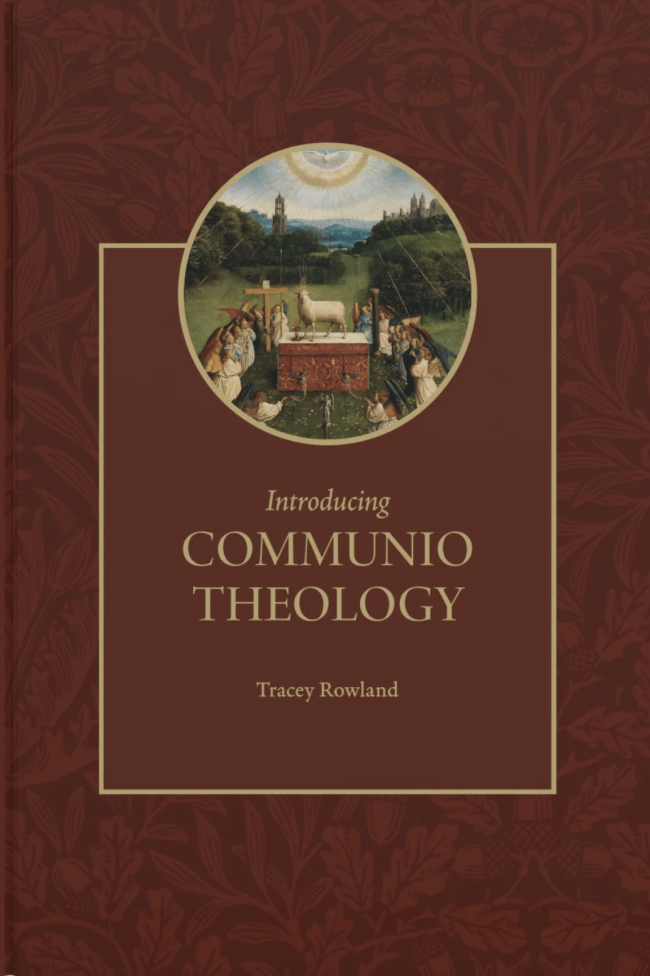
Introducing Communio Theology (Word on Fire Academic, 2025) is a 396-page hardcover survey of one of the most significant Catholic theological movements of the past half-century. Written by Tracey Rowland — holder of the St. John Paul II Chair of Theology at the University of Notre Dame (Australia) and winner of the 2020 Ratzinger Prize — the book traces the origins, key figures, and ongoing relevance of the Communio school, founded in the early 1970s by Henri de Lubac, Hans Urs von Balthasar, and Joseph Ratzinger, among others. Rowland characterizes Communio as "more a dynamic sensibility than a school of thought in the strict sense."¹ Its animating impulse was a critical response to the theological currents that emerged in the wake of the Second Vatican Council — particularly those that, in the Communio thinkers' view, accommodated the Gospel too readily to modern secular frameworks. The movement took its name from the international journal Communio, and grew out of deep personal friendships and shared commitments across national and cultural boundaries. At its heart, Communio theology seeks to hold together pairings that modern thought tends to split apart: nature and grace, Scripture and Tradition, faith and reason. Rowland structures the book across ten chapters, each addressing a different domain where Communio theology has made a distinctive contribution. The book opens with a theological account of communio itself as a gift of the Holy Spirit, before profiling the three founding figures. Subsequent chapters address the contested question of how to interpret Vatican II, the Communio understanding of Tradition, and the principles governing scriptural exegesis within the horizon of faith. Rowland then turns to applied topics: Christocentric moral theology, a Communio-inflected engagement with feminism, the theology of the sacramental presbyterate, Christian cosmology and ecological stewardship, and — in the final chapter — the theological genealogy of secularism in modern and postmodern cultures. The author is candid about the polemical dimension of her project. As she writes in the book's preface, "This book is written in the desire to help the younger generations to separate the wheat from the chaff of postconciliar theology."² This is not a neutral survey but an engaged argument, and reviewers have recognized it as such. Tibor Görföl notes that the book is written "with an engaged, sometimes even harsh passion for truth" and describes it as "a theology unconformed to the age; yet it is much more than a countercultural protest — it's an invitation to become Catholic in all the dimensions of culture."³ D.C. Schindler, editor of the English-language Communio journal, calls it "an accessible introduction to the history and distinctive theological positions of the Communio thinkers, clearly explained by someone intimately acquainted with the deepest inspirations of this movement."⁴ Larry Chapp adds that the book is "far more than an introduction — it gives us a robust account of the Communio theological project that is deeply pertinent to our times."⁵ Endnotes Tracey Rowland, Introducing Communio Theology (Park Ridge, IL: Word on Fire Academic, 2025), publisher's description, bookstore.wordonfire.org/collections/all/products/communio-theology. Rowland, Introducing Communio Theology, Preface. Quoted on the Word on Fire product page. Tibor Görföl, endorsement of Introducing Communio Theology, Word on Fire Academic product page. D.C. Schindler, endorsement of Introducing Communio Theology, Word on Fire Academic product page. Larry Chapp, endorsement of Introducing Communio Theology, Word on Fire Academic product page.
✓ Strengths
- ✓Grounds ecclesiology in Trinitarian communion rather than mere institutional structure, so the Church is understood as participation in the divine life of Father, Son, and Holy Spirit — a directly anthropological claim about what human beings are made for.
- ✓The communio framework addresses the Created state directly: the person's social nature is not accidental but constitutive, reflecting the imago Dei as inherently relational and ordered toward gift-of-self.
- ✓By situating the laity, clergy, and religious within a single communio rather than a clerical hierarchy with laypeople at the bottom, the book corrects a Fallen distortion — the reduction of persons to functional roles — and recovers their full baptismal dignity.
- ✓The theology of communio opens a Redeemed anthropology of vocation: each state of life (married, ordained, consecrated) is ordered toward and for the others, not in competition, which maps precisely onto the CCMMP premise that redemption restores right relationship.
- ✓Published by Word on Fire, the volume is positioned to reach readers who may have no prior exposure to the communio school, making sophisticated post-conciliar ecclesiology accessible without diluting its substance.