I Am a Son of Saint Augustine: Pope Leo XIV on His Favorite Saint
by Pope Leo XIV
Virtue scores
Review
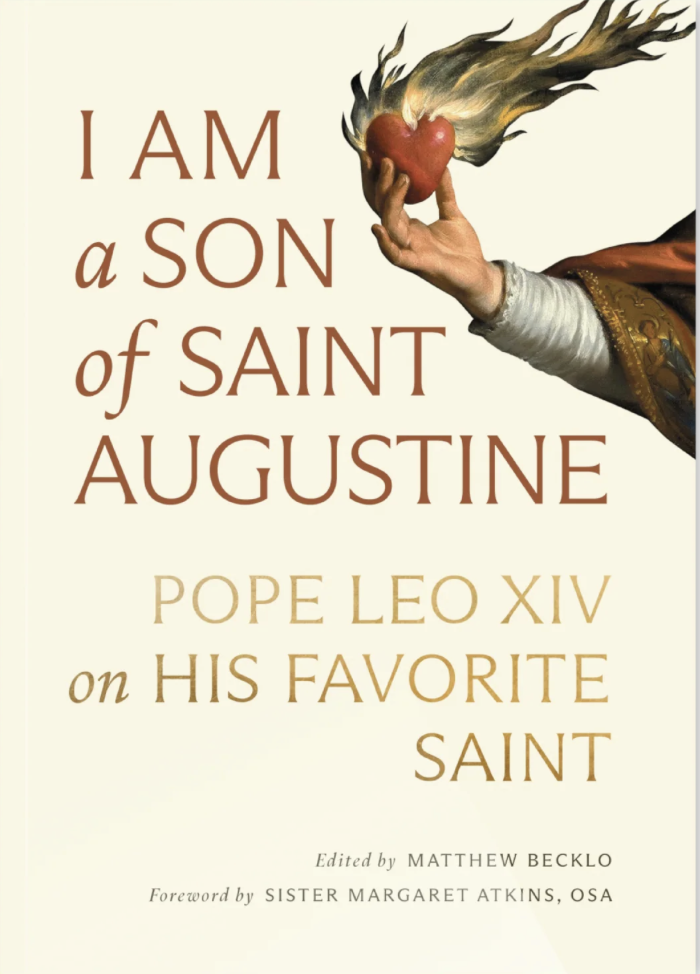
I Am a Son of Saint Augustine: Pope Leo XIV on His Favorite Saint Edited by Matthew Becklo | Word on Fire, 2026 | 104 pp. When Robert Francis Prevost stepped onto the loggia of St. Peter's Basilica on May 8, 2025, his first words after the traditional blessing placed him firmly within a millennium-and-a-half-old tradition: "I am an Augustinian, a son of Saint Augustine, who once said, 'With you I am a Christian, and for you I am a bishop.'"¹ That self-identification is the animating premise of this slender but substantive volume, which editor Matthew Becklo has assembled as both a theological portrait and a primary-source record of the new pope's Augustinian formation. The book draws on an unusually diverse archive. Alongside excerpts from early papal audiences and homilies, it includes original translations of Spanish-language messages Prevost delivered during his years in Latin America and, most strikingly, passages from his doctoral dissertation on the role and authority of the local prior in the Order of Saint Augustine.² That academic work surfaces here not as mere biography but as doctrinal substance: Prevost's scholarly attention to the prior's office—its communal accountability, its servant-leadership model—anticipates the ecclesiology he has carried to Rome. Sister Margaret Atkins, OSA, whose foreword traces the deep grammar of Augustinian life, identifies the recurring themes: restlessness for God, the priority of community, friendship as a spiritual practice, and a ceaseless orientation toward truth. The motto Prevost chose upon his election—In Illo uno unum ("In that One, [we are] one"), drawn from Augustine's homily on Psalm 128—compresses these threads into a single phrase.³ It is a motto that names both a mystical aspiration and a program for synodal governance. A brief anecdote from Father Ian Wilson, OSA, recounted in the foreword, grounds the theology in lived particularity: before the conclave, Prevost was known at the Augustinian Curia in Rome simply as a man who showed up for community life without ceremony.⁴ The book's supplementary materials—a timeline of Prevost's life, the full text of The Rule of Saint Augustine, and key Augustinian passages—extend that portrait into a compact reference for anyone wishing to understand the intellectual and spiritual inheritance the new pope carries to the Chair of Peter. Endnotes ¹ Pope Leo XIV, First Blessing, May 8, 2025, quoted in I Am a Son of Saint Augustine, Word on Fire product page, https://bookstore.wordonfire.org/products/i-am-a-son-of-saint-augustine?variant=45145733857337. ² I Am a Son of Saint Augustine Preview PDF, p. 5–6, https://storage.googleapis.com/media.wordonfire.org/books/I%20Am%20A%20Son%20of%20Saint%20Augustine%20-%20Preview.pdf. ³ Word on Fire product page (see note 1). ⁴ Preview PDF, foreword by Sr. Margaret Atkins, OSA, p. 3.
✓ Strengths
- ✓Frames the Christian life explicitly through filial identity — the reader is positioned not as a moral striver but as a son who already belongs to a Father, grounding spiritual effort in received dignity rather than earned standing.
- ✓Published by Word on Fire, the book operates within a tradition of theologically serious popular formation, signaling Augustine of Hippo as the primary interlocutor — Augustine's own restless-heart anthropology runs directly through the title.
- ✓The Augustinian lineage connects naturally to the CCMMP's Created premise: the person is made for communion, and disorder arises precisely because that original orientation toward the Good becomes distorted rather than destroyed.
- ✓Devotion (justice-devotion) and adoration (justice-adoration) are likely structural concerns of the text, since Augustine's theological program moves from confession of sin toward sustained worship as the proper posture of the restored self.
- ✓The filial framing supports prudence-memory in a specific way: Augustinian spirituality requires the reader to narrate their own life backward, recognizing God's prior action, which trains the integral virtue of learning from experience.