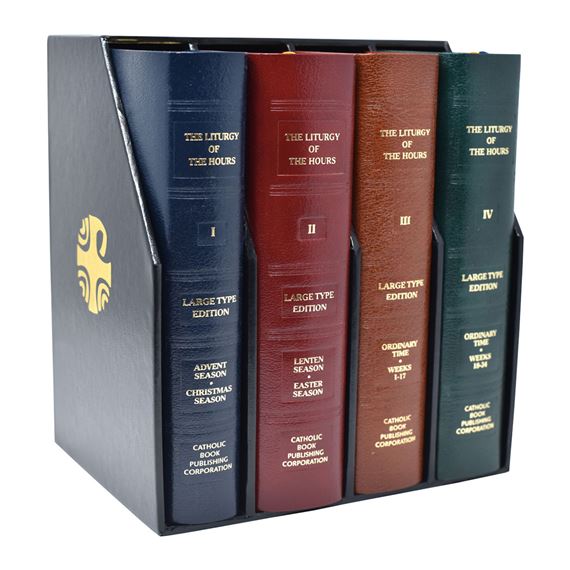
LARGE PRINT 4-VOLUME LITURGY OF THE HOURS
Publisher
EWTN Religious Catalogue
Published
June 17, 2026
ISBN
cp-large-print-4-volume-liturgy-of-the-hour
Virtue scores
Review
SECTION ONE For Catholics whose eyesight makes standard breviary type a daily frustration, this four-volume large-print edition of the Liturgy of the Hours from the EWTN Religious Catalogue answers a specific and underserved need. The Liturgy of the Hours — the Divine Office — is the Church's own prayer, structured across five daily 'hours' that mark morning, midday, evening, and night with Psalms, Scripture readings, canticles, and patristic homilies. It is not a devotional supplement; it is the prayer the Church formally commissions for daily recitation by clergy, religious, and the faithful. Spread across four volumes, each Office is given the physical space it deserves without the eye strain that single-volume editions demand of older readers. For a retired parishioner, a hospital chaplain, or a consecrated woman whose vision has changed, this edition makes daily fidelity to the Hours possible where it had become difficult. The publisher is EWTN Religious Catalogue, a trusted source for liturgically sound Catholic devotional materials. SECTION TWO - **Created**: The Hours presuppose that time itself is sacred — that morning, noon, and night are not neutral intervals but moments already charged with theological meaning. By sanctifying the structure of the day, the text affirms the CCMMP's premise that the human person is not a soul temporarily housed in a body but a bodily creature whose biological rhythms are themselves suited to worship. Rising to pray at dawn is not a spiritual exercise performed despite the body; it is the body and soul acting together as they were made to act. - **Fallen**: The practice of the Hours addresses a specific disorder in the fallen person: the tendency to let time dissolve into distraction, appetite, and self-referential concern. Concupiscence, in Aquinas's account, is not only disordered sexual desire but any appetite that pulls the will away from its proper orientation. The daily return to fixed prayer — even on days when consolation is absent — is a discipline aimed directly at that drift, training the will to return to God by habit rather than by mood. - **Redeemed**: The patristic and Scripture readings embedded in each Office trace the arc of salvation history across the liturgical year, so that the person who prays the Hours regularly is slowly formed in the Church's memory of redemption. This is not passive reading; the Hours require the reader to say the words aloud or in directed attention, making each prayer an act rather than an idea. The theological virtues — faith, hope, and charity — are exercised in the act of praying Scripture one believes, hopes in, and loves. - **Justice (devotion and worship)**: The virtue of religion, as a part of justice, is the stable disposition to render to God what is owed. The Hours are its most structured form: a daily, weekly, and seasonal rhythm of acts of adoration, thanksgiving, petition, and praise, calibrated to the Church's liturgical calendar. Praying them consistently over years is not repetition for its own sake but the formation of a person who relates to God as one who owes God worship — and who finds, over time, that the debt feels less like obligation and more like desire. - **Prudence (memory)**: Aquinas argues that prudence depends on a trained memory — the capacity to recall past experience accurately and apply it to present judgment. The Psalms of the Hours, many of them laments or thanksgivings drawn from Israel's specific historical encounters with God, function precisely as a school of sacred memory. The person who has prayed Psalm 22 through genuine suffering carries a different cognitive and affective resource for future suffering than the person who encountered it only as a text. SECTION THREE The Spiritual Exercises of St. Ignatius of Loyola[^1] rest on a premise that resonates directly with the Hours: that 'the Christian religion cannot long subsist without some spiritual exercises and meditations.'[^1] Where the Exercises provide an intensive, retreatant's encounter with the mysteries of Christ, the Hours provide the daily, distributed form of the same orientation — a structure that keeps the soul returning to God not in a single focused moment but across every natural division of the day. Teresa of Avila's[^2] instruction in the Way of Perfection that 'by striving always to walk in the love and fear of God, we shall travel safely amid all these temptations'[^2] describes the anthropological effect the Hours are designed to produce: not a single act of courage but a habituated posture of recollection. The entry in the Royo Marin-adjacent liturgical literature catalogued under El ano liturgico and El breviario[^3] confirms that the breviary tradition has long been understood, within the Spanish ascetical-theological canon, as a complement to systematic mystical theology rather than a substitute for it. ## References [^1]: Ignatius of Loyola. (1914). *Spiritual Exercises of St. Ignatius of Loyola* (Elder Mullan, Trans.). P. J. Kenedy & Sons. Approval text, Literal Version. [^2]: Teresa of Avila, St. (1946). *Way of Perfection* (E. Allison Peers, Trans.). Sheed & Ward. ch. 40. [^3]: Righetti, M. (n.d.). *Historia de la Liturgia* [DMU canon bibliography entry]. BAC. Vol. I, El ano liturgico / El breviario.
✓ Strengths
- ✓The Liturgy of the Hours is the official prayer of the Church, sanctioned for daily use by clergy, religious, and laity alike; this large-print edition removes a concrete physical barrier — failing eyesight — that might otherwise exclude older Catholics or those with visual impairments from full participation in the Church's daily prayer.
- ✓By structuring prayer around the natural rhythm of the day (Office of Readings, Morning Prayer, Daytime Prayer, Evening Prayer, Night Prayer), the text trains the body and the soul together in an ordered relation to time, directly expressing the CCMMP's premise that the person is a unity of body and soul rather than a disembodied spiritual agent.
- ✓The Psalms, canticles, Scripture readings, and patristic homilies woven through each hour constitute an act of the virtue of religion (justice-worship) in its most formal sense: the creature rendering to God what is owed, in forms the Church has tested and ratified across centuries.
- ✓The four-volume large-print format signals a practical commitment to the accessibility of communal prayer across the lifespan, supporting elderly and infirm Catholics in sustaining a devotional identity that might otherwise erode with age.
- ✓The daily repetition of the Hours forms the integral virtue of memory (prudence-memory) by embedding Scripture, doctrine, and praise into habitual cognition — precisely the mechanism Aquinas describes when he argues that repeated acts stabilize a disposition toward their object.
⚠ Considerations
- ⚠Because no description or editorial apparatus is available for this specific edition, it is impossible to verify whether the translation used is the ICEL 1975 edition or a later revision, which matters pastorally for parishes and communities with strong liturgical sensibilities around translation quality.
- ⚠A four-volume large-print set carries a higher price point and greater physical bulk than single-volume alternatives; readers seeking portability for travel or hospital ministry may find this format impractical without supplementary pocket editions.
- ⚠A new translation will soon be introduced.