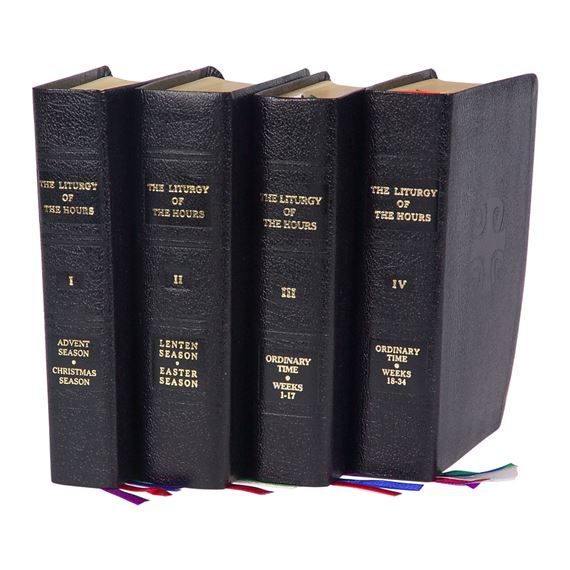
4-VOLUME LITURGY OF THE HOURS - LEATHER
Publisher
EWTN Religious Catalogue
Published
June 17, 2026
ISBN
cp-4-volume-liturgy-of-the-hours---leather
Virtue scores
Review
SECTION ONE Seven times a day the Church prays. That simple discipline, drawn from Psalm 119, is what the four-volume leather Liturgy of the Hours makes possible in the hands of any Catholic willing to pick it up. The Divine Office — the official daily prayer of the Roman Rite — structures Morning Prayer, Daytime Prayer, Evening Prayer, Night Prayer, and the Office of Readings across the full liturgical year, threading the psalter, canticles, patristic readings, and intercessions through every waking hour. The four-volume leather set presents this cycle in its complete form, the same prayer that priests, deacons, religious, and many laypeople pray in common around the world each day. It is not devotional reading in the ordinary sense; it is the Church's act of worship rendered in time, and the person who prays it consistently finds that the psalms gradually become the grammar of their interior life. This edition is suited to anyone seeking to enter the full breadth of the Church's liturgical prayer — seminarians, religious, lay Catholics in serious formation, and parishes that want to anchor communal life in the Hours. SECTION TWO - **Created**: The Liturgy of the Hours affirms that time itself belongs to God. By consecrating morning, midday, evening, and night to explicit praise, the Hours ground human temporality in the imago Dei — the person is not merely a biological clock but a creature whose whole day is ordered toward communion with the Creator. This is the anthropological premise the CCMMP calls the unity of body and soul: the body shows up at a fixed hour; the soul attends to God through the words of Scripture. - **Fallen**: The Hours diagnose the fallen condition by requiring their practitioner to pray the psalms of lament, imprecation, and desolation as well as the psalms of praise. The pray-er who recites Psalm 88 ('I am overwhelmed with trouble; I am at the brink of death') is not performing optimism but naming the disordered experience of a world marked by suffering — and naming it before God rather than suppressing it. This is a concrete counter to the concupiscent tendency to manage grief alone. - **Redeemed**: The annual cycle of the liturgical year embedded in the four-volume structure moves the person through Advent, Christmas, Lent, Easter, and Ordinary Time — a repeated immersion in the Paschal Mystery. Each year the pray-er dies and rises again with the Church, which is the redemptive arc the CCMMP identifies as restoration through grace made concrete in the life of the community. - **Justice (devotion)**: Praying the Hours at fixed times — dawn, noon, dusk, night — is a school of the virtue of devotion as Aquinas describes it in the Summa: the prompt and generous movement of the will toward God. The leather binding and four-volume completeness signal a commitment designed to last decades, not weeks. - **Prudence (memory)**: The psalter is a treasury of accumulated wisdom about human experience — victory, defeat, exile, return, trust, and betrayal — and praying through it repeatedly forms the integral virtue of memory: the capacity to read present situations through the lens of a deep, tested past. SECTION THREE The approval text appended to the Spiritual Exercises, notes that 'the Christian religion cannot long subsist without some spiritual exercises and meditations — for the Psalmist says: In my meditation a fire flames out'[^1] — a sentence that reads, in hindsight, as a description of exactly what the Liturgy of the Hours has been supplying to the Church for fifteen centuries. ## References [^1]: Ignatius of Loyola. (1914). *Spiritual exercises of St. Ignatius of Loyola* (E. Mullan, Trans.). P.J. Kenedy & Sons. Approval text, Fr. Aegidius Foscararius.
✓ Strengths
- ✓The Liturgy of the Hours is the Church's official prayer of the Divine Office, structured to sanctify each hour of the day through psalms, canticles, Scripture readings, and intercessions — orienting the entire rhythm of human time toward God.
- ✓Praying the Hours in the leather 4-volume edition places the practitioner within the full annual cycle of the Church's liturgical year, forming memory and attention through daily repetition of the psalter — a concrete mechanism for what Aquinas calls the habituation of the will toward God.
- ✓The act of praying the Hours at fixed times requires a daily sacrifice of ordinary activity, directly training the virtue of religion as Aquinas describes it: the habitual rendering of what is owed to God in worship.
- ✓The Hours draw the pray-er into the communal voice of the Church across time, forming solidarity with the whole Body of Christ — a concrete exercise of the 'unity of body and soul in community' that the CCMMP identifies as intrinsic to created personhood.
- ✓The leather 4-volume format, designed for sustained daily use over a lifetime, supports the virtue of commitment (vows) by making the long-term practice of the Office physically durable and liturgically complete.
⚠ Considerations
- ⚠Without pastoral accompaniment or formation in how to read the rubrics, new users may find the four-volume structure technically demanding; a companion guide or parish formation program is advisable alongside the text.
- ⚠The absence of any descriptive content in the product listing means potential buyers cannot verify which translation or edition this set follows — the 1975 ICEL translation, the newer English versions, or another — which matters for liturgical precision and compatibility with parish use.
- ⚠A new English translation will soon be implemented.