Virtue scores
Review
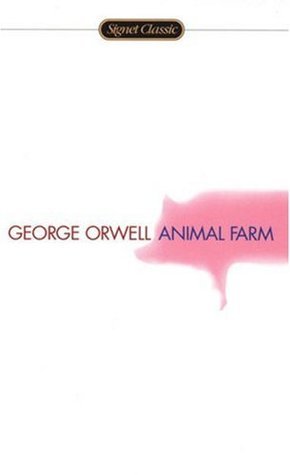
SECTION ONE George Orwell finished Animal Farm in 1944, but it took him nearly two years to find a publisher willing to print it. The story is short — a barnyard fable in which overworked animals overthrow their drunken farmer, establish a republic of shared labor and equal rights, and then watch the pigs who led the revolution consolidate every privilege they overthrew. By the final page the commandment 'All animals are equal' has been quietly amended to read 'All animals are equal, but some animals are more equal than others.' Orwell wrote it as a direct, unsparing account of how revolutionary idealism becomes the instrument of the very tyranny it claimed to abolish — specifically, how the Soviet experiment under Stalin devoured its own founding promises. Russell Baker's introduction and C. M. Woodhouse's afterword frame the historical context so that first-time readers understand both the target and the method. The audience is anyone who wants to understand how political language is weaponized and how good intentions, without institutional checks, can be turned against the people they were meant to serve. SECTION TWO - **Created**: Orwell's fable rests on an implicit claim that the animals' original grievance is legitimate — that labor deserves its fruit, that creatures capable of reason and solidarity should not be exploited by a master who contributes nothing. The opening vision of Major's speech, in which he names the dignity of animal labor, carries the structural weight of an original goodness that the revolution then fails to protect. The imago Dei is not Orwell's language, but the moral logic requires something like it: the animals' exploitation is wrong because they are capable of community and purpose, not merely because it is inefficient. - **Fallen**: The novella's true subject is concupiscence at the collective level. Napoleon does not seize power in one dramatic coup; he does it through a series of small, rationalizable steps — keeping the milk and apples, expelling Snowball, rewriting the commandments by night. Aquinas's account of how disordered appetite advances through the will by habituating the intellect to accept smaller and smaller distortions finds a literary correlate in the pigs' incremental revision of the Seven Commandments. The disorder is not passion overwhelming reason in a single moment; it is reason itself being bent, gradually, into the service of appetite. - **Fallen (social dimension)**: The sheep, who drown out debate by bleating slogans on cue, illustrate what Aquinas calls the privation of practical reason in a community: when prudence-civic-wisdom fails across an entire population, the space for correction collapses. The animals who might have objected lack the language, the memory, or the courage to name what is happening — each deficiency mapping onto a distinct integral vice opposed to prudence. - **Redeemed**: This is where the novella is most limited as a resource for Catholic readers. Orwell provides no redemptive arc. The final chapter, in which the pigs walk on two legs and the other animals can no longer distinguish pig from man, closes without any horizon of restoration. The absence is instructive: a Catholic reading of the book uses this gap to ask what would have to be true about persons — their dignity, their end, the grace available to them — for the story to end differently. - **Prudence (memory and foresight)**: The old cart-horse Boxer's motto, 'I will work harder,' is Orwell's indictment of uncritical industry divorced from prudence-memory. Boxer cannot remember, cannot read, and will not question. His fate — sold to the knacker while the other animals are told he died in a hospital — is Orwell's argument that labor without prudence is not virtue but vulnerability. Catholic readers training in prudence-foresight will find the book useful precisely because Orwell makes the logic of exploitation visible one step at a time. SECTION THREE Schumpeter[^1], writing in the same historical moment as Orwell, argued in Capitalism, Socialism and Democracy that socialist institutions tend to produce a managerial class whose interests diverge from those of the workers the system was built to serve — a structural prediction that Animal Farm dramatizes at the level of character and incident. Where Schumpeter analyzes the mechanism in economic and sociological terms, Orwell renders it as moral psychology: the same process of elite capture, but seen from the inside of the animals who are captured. ## References 1. Schumpeter, Joseph (1950). *Capitalism, Socialism and Democracy*. — 'Capitalism Socialism and Democracy by Joseph Schumpeter'
✓ Strengths
- ✓The novella offers a precise anatomy of how power corrupts collective life: Napoleon's incremental seizure of the farm's governance shows, step by step, how disordered appetites for dominance override the original intentions of a community formed around legitimate grievance.
- ✓Orwell's use of the pigs' manipulation of language — 'Four legs good, two legs bad' collapsing eventually into 'Four legs good, two legs better' — is one of the most economical literary treatments of how dishonesty destroys the social bonds that justice requires.
- ✓The character of Boxer, the horse who labors faithfully under false promises until he is sold to the knacker, gives Catholic readers a pointed study in misplaced obedience: genuine justice-obedience requires a legitimate authority, and Boxer's tragedy is the tragedy of virtue directed toward a corrupted end.
- ✓The foresight built into the narrative structure — Orwell wrote the book in 1943-45 as a direct warning about Stalinist totalitarianism — trains the reader's own prudence-foresight: the logic of each step in the animals' dispossession is made visible precisely so that readers can recognize the pattern before it completes.
- ✓Benjamin the donkey, who sees through every lie but withholds his knowledge out of a kind of cynical detachment, functions as Orwell's implicit argument that clear sight without courageous speech is its own moral failure — a direct illustration of why prudence-sound-judgment must issue in action.
⚠ Considerations
- ⚠The novella offers no path of redemption or restoration: the final scene in which the pigs and men are indistinguishable ends in despair, not transformation. Catholic readers should note that Orwell's anthropology is fundamentally pessimistic — the Fallen condition is diagnosed with surgical accuracy, but the Redeemed state is simply absent from his imaginative world.
- ⚠Orwell wrote from a secular socialist standpoint; his critique of ideology is not grounded in any account of natural law or transcendent dignity. The imago Dei, which grounds the Catholic claim that persons cannot be instrumentalized, is not available to Orwell's argument — he relies entirely on the observable consequences of tyranny rather than on the intrinsic wrong of treating persons as tools.
- ⚠The book's brevity (approximately 30,000 words) can lead readers to treat its political diagnosis as exhaustive. It is a powerful parable, but a parable about power without a theology of the person leaves the reader with diagnosis and no medicine.